
AI video clipper features, from upload to export
Upload a recording, read why each moment was suggested, move the cut, fix the words, choose the frame, and download a captioned MP4. Every decision stays yours.
What Clyps does at each step of the edit
Four stages, in the order you meet them. Nothing here happens without a preview you can check first.
Bring the recording
One private upload, straight from the file you already have.
- MP4, MOV, M4V, and WebM up to 20 GB per file.
- Around 40 minutes or shorter is the length that transcribes reliably.
- Uploads continue while the upload page stays open.
Find the moment
Suggestions you can check, not a black box that hands you an answer.
- A timed transcript with per-word timing when the recording supports it.
- Every suggestion carries a title, a score, and a written reason.
- You choose which moments are worth shaping, and where they start.
Shape the frame
Keep the person in view, in the shape the next post needs.
- Six framing modes Center, Manual, Fit, Fill, Auto follow, Split screen.
- Four aspect ratios 9:16, 16:9, 1:1, and 4:5.
- Auto follow tracks a person in footage where a face can be followed.
Finish and export
Type, timing, and wording stay editable until you are happy.
- Caption templates with editable type, color, position, and timing.
- Per-word corrections when word timing is available for the clip.
- H.264 MP4 at 720p, 1080p, or 4K keeps going after you close the page.
Where you will spend your time
See the change before you export
Correct the transcript, adjust the cut, and preview your caption style on the real frame. Exporting does not lock the clip.
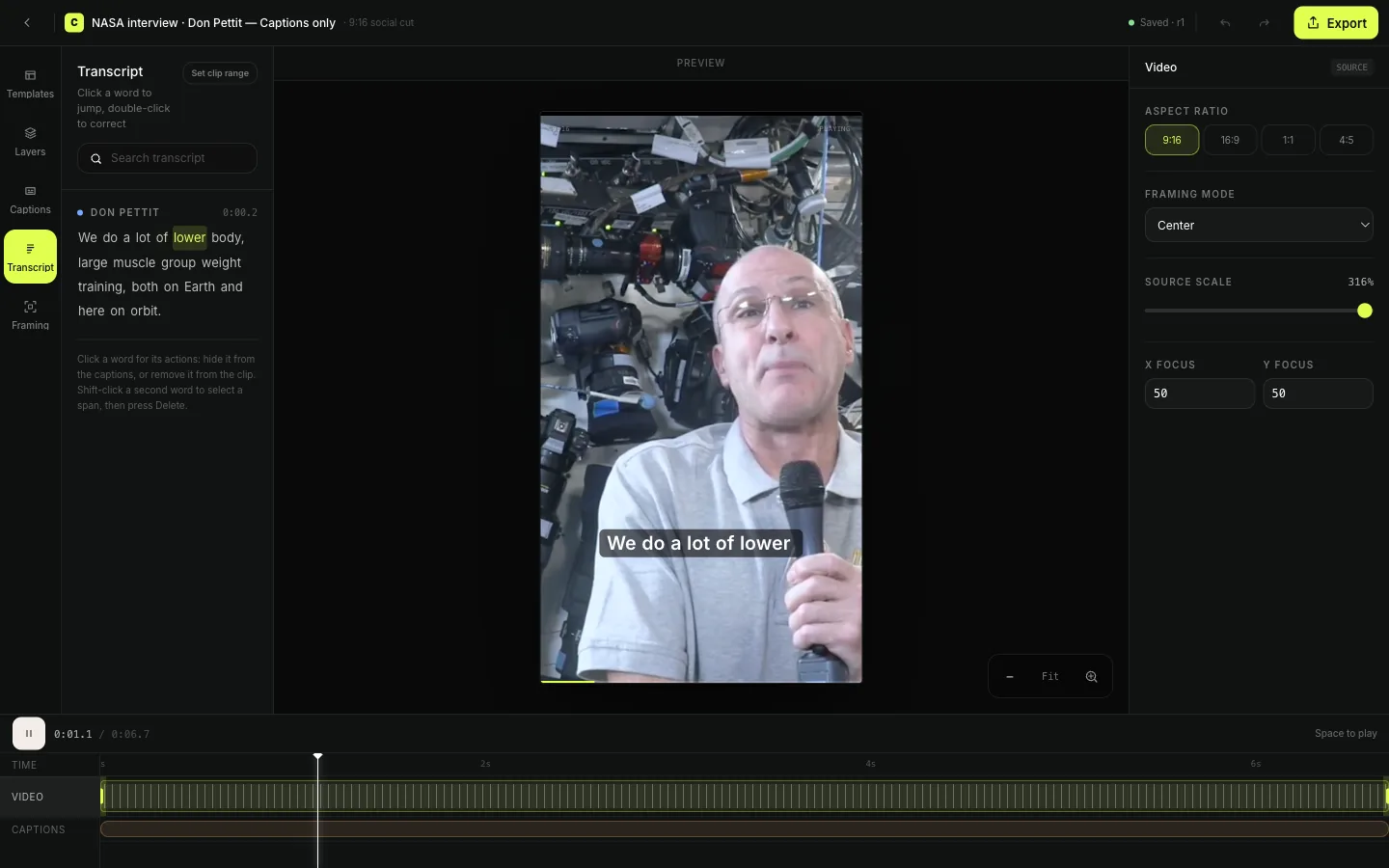
One recording, four shapes
Export a captioned MP4 in the shape your next post needs.
Upload and export details
| Input | Editing | Output |
|---|---|---|
| MP4, MOV, M4V, WebM up to 20 GB; around 40 minutes or shorter recommended | Editable transcript, captions, framing and clip range | 720p, 1080p or 4K MP4; 9:16, 16:9, 1:1 or 4:5 |
Uploads continue while the upload page stays open. Exports keep going after you close the page.
A few practical answers
- Can I import a YouTube video by URL?
- YouTube URL import is coming soon. For now, upload your original video file, review the suggested moments, and export your clips.
- What kind of video should you bring to Clyps?
- Bring a spoken recording such as an interview, podcast, webinar, conference talk, lesson, product demo, or stream. Clyps accepts MP4, MOV, M4V, and WebM files up to 20 GB. Keep each recording around 40 minutes or shorter for reliable transcription.
- Does Clyps publish clips automatically?
- No. Clyps suggests clips with a title, a score, and a written reason, and you decide which ones are worth shaping. You review the shortlist in the studio editor before anything is exported.
- How much of the result can you change?
- The clip range, framing mode, aspect ratio, caption template, and caption styling stay editable. When word timing is available, you can also correct or remove transcript words. Visual changes appear in the preview before export, and exporting does not lock the clip.
- What happens after I start an export?
- Clyps creates an H.264 MP4 at 720p, 1080p, or 4K. The export keeps going if you reload or close the page, so you can come back later to download it.
See what your recording can become.
Start free with your own video. Keep every edit in your hands.
Create your Clyps account