How to make YouTube clips with Clyps
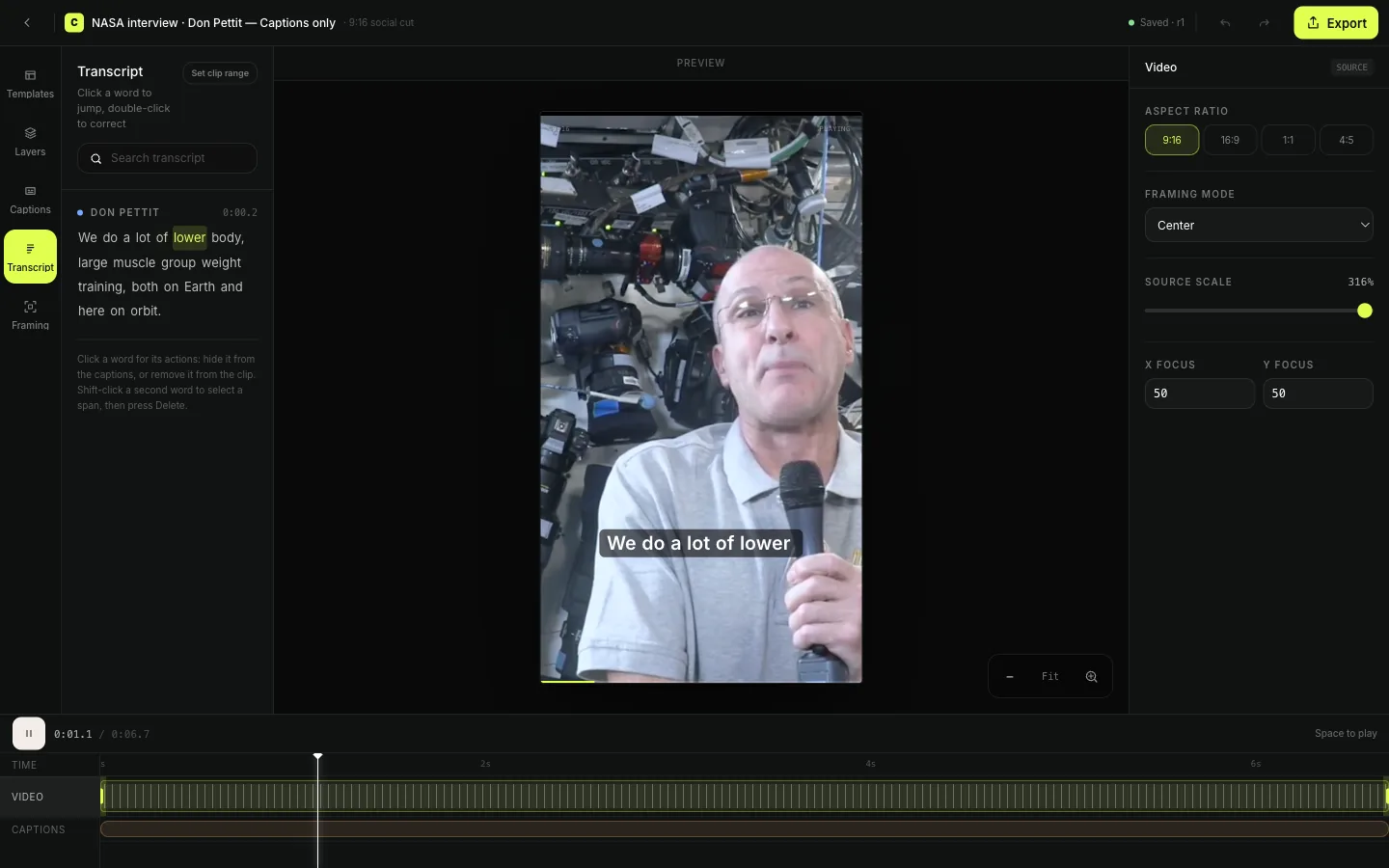
Upload your source video and let Clyps transcribe the speech and suggest highlights. Open a candidate to see its title, score, and reason. Adjust the start and end so the idea stands on its own. Correct the captions, choose a frame, preview the whole clip, and export an MP4. You upload the finished file through YouTube.
Make a Short or keep the landscape frame
Choose 9:16 for a vertical Short or 16:9 for a landscape excerpt. Clyps also supports 1:1 and 4:5. Auto follow keeps a tracked person in frame; split screen can show two people together. Check speaker changes and any object the presenter points to. A centered face does not help if the demonstration has been cropped out.
Keep control of the words and the cut
Suggested highlights are starting points. Extend a clip if it begins after the question, and keep a qualification that changes the answer. Correct names in the transcript, change caption style and placement, and preview the result in your browser before export. Optional stock B-roll can illustrate a point while the recorded speech continues. A clip score helps organize your review; it does not predict views.
Worked example: one complete answer from an interview
Suppose an interview about hiring contains an answer that begins, "We stopped doing that." The sentence is incomplete without the question about take-home assignments. Move the start earlier to include that question. Keep the example of what replaced the assignment, then end before the interview moves to salaries. Use split screen during the exchange and check the guest name in captions. Export vertically for a Short or keep a landscape version for your channel. These are editing choices for an illustrative example, not a claim about automatic results.
Try the workflow with a recording you already own
Clyps Free includes 30 source minutes, 10 finished video minutes, and three exports per month. Free exports carry a Clyps watermark and free media expires after seven days. Creator starts at $19 monthly, with 300 source minutes, 120 finished minutes, and 60 exports per month, without the Clyps watermark. Upload MP4, MOV, M4V, or WebM. Keep recordings around 40 minutes or shorter for reliable transcription and within your plan allowance.
Before you export
- The opening names the subject without relying on the full video title.
- The cut preserves the answer and any condition attached to it.
- Names and numbers in captions match the audio.
- The frame keeps both the speaker and the relevant demonstration visible.
- The downloaded MP4 plays correctly before you upload it.
See the edit before you export
YouTube clip maker questions
- Can I paste a YouTube URL into this clip maker?
- Not yet. Clyps currently starts from an uploaded video file. Use the original recording you own or have permission to edit. This page does not offer a YouTube downloader.
- Is this the same as sharing a Clip on YouTube?
- No. YouTube describes its Clip sharing feature as a 5-to-60-second segment played from the original watch page. Clyps creates a separately edited MP4 from your uploaded source. Choose Clyps when you need a new crop, captions, or a file for another upload.
- Can I make YouTube clips for free?
- Yes. Clyps Free provides 30 source minutes, 10 finished minutes, and three exports per month. The exported video has a Clyps watermark. Paid plans remove that watermark. Free media expires after seven days.
- Can I download a clip as an MP4?
- Yes. Clyps exports H.264 MP4 at 720p, 1080p, or 4K. Choose an aspect ratio for the destination and review the downloaded file before uploading it.
- Does Clyps post clips to my YouTube channel?
- No. Download the MP4 from Clyps, then upload and manage the post in YouTube. Direct external publishing and scheduling are not currently available.