
Review the editorial decision first
Read the reason for a suggested clip and listen to it with the surrounding context. Keep the idea if it serves your audience. Change the boundaries if the AI omitted a setup line or included a second topic. The suggestion reduces the search through the recording; it does not replace your judgment.
Work through picture and text together
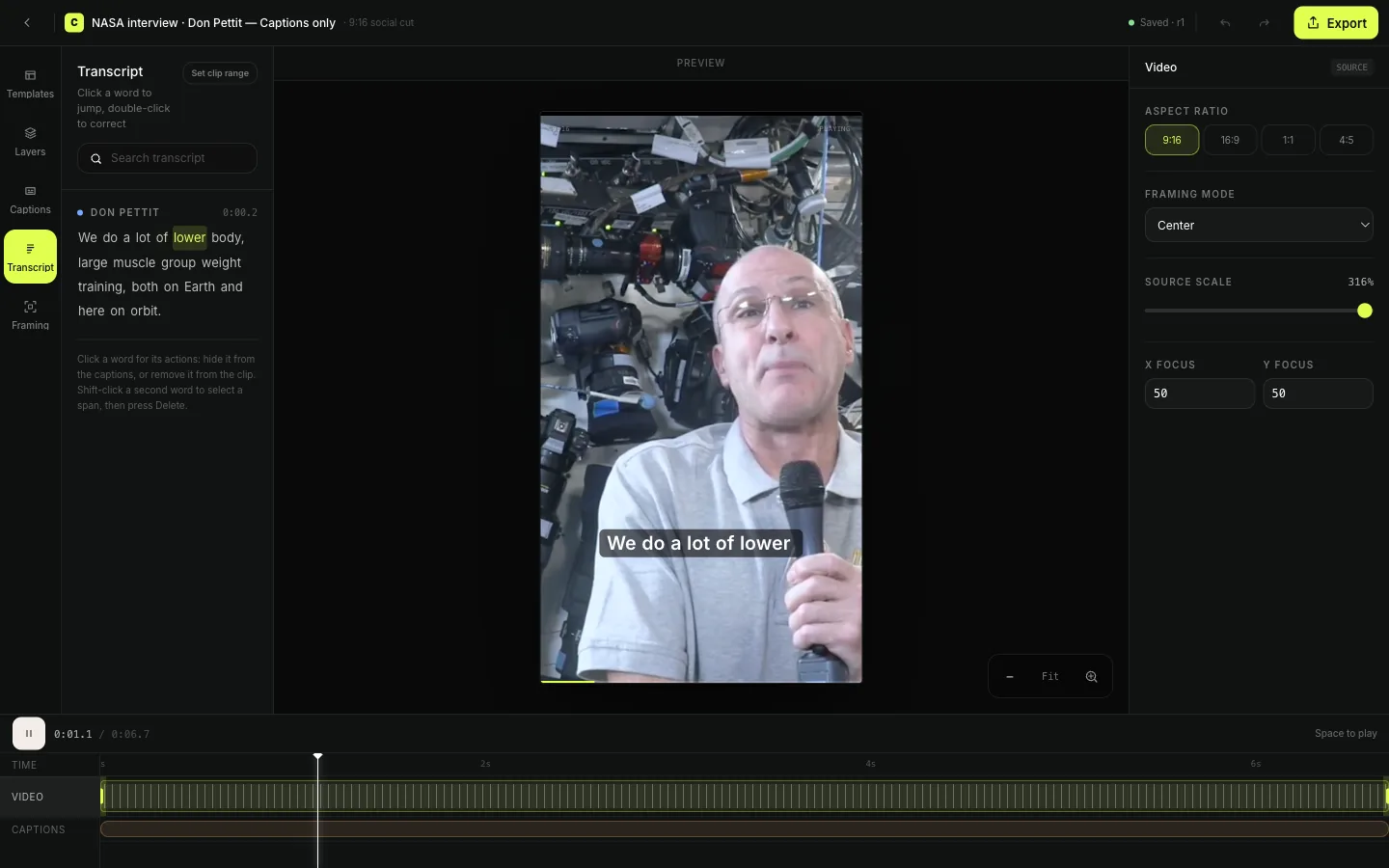
A caption treatment that looks good over a talking head may cover the key information in a screen demonstration. Adjust the frame, correct the transcript, and preview the text as a single composition. Visual edits preview in the browser so you can compare choices before exporting.
Choose the right job for this editor
Clyps is built around turning an existing recording into finished short clips. If your project needs new generated scenes, complex compositing, or a long sequence assembled from many source files, plan those steps in the tools that support them. Use Clyps where clip selection, framing, and speech captions are the main work.
Worked example: one candidate, several editorial decisions
Suppose Clyps suggests a passage in which a guest explains a common customer mistake. First check the context and extend the opening if the customer’s problem is unnamed. Next choose the frame: keep the guest alone for the explanation or retain both speakers if the exchange matters. Correct the product name in the transcript, then choose a caption treatment that does not cover the guest’s gestures. Preview the passage with those choices together before exporting. Each decision solves a different problem, so evaluate the final composition rather than approving the range, crop, and text as unrelated pieces.
Keep source quality separate from edit quality
An editor cannot recover a missing explanation, an offscreen object, or unintelligible audio simply by changing the presentation. Return to the recording when an issue comes from the source. Select a cleaner candidate if possible, or record the missing material in your normal production workflow. That judgment is part of making a useful finished video.
Before you export
- The candidate serves a defined audience question.
- The range preserves the speaker’s meaning.
- Framing and captions are reviewed together.
- The export is checked rather than assumed from the preview.
See the edit before you export
AI video editor questions
- Do I need to render after each style change?
- Visual edits preview locally in the browser. Start an export when you want a finished video file.
- Can I correct the transcript?
- Yes. Review and correct the text used for captions. Individual word controls depend on the timing available for that transcript.