
Find the true beginning
Remove dead air and introductions that do not help the excerpt, but keep the phrase that identifies the topic. Listen for a cut that begins on a pronoun, half a word, or a response to an unheard question. Extend the range when the missing setup would confuse a new viewer.
Let the ending resolve
The first strong sentence is not always the end of the idea. A speaker may follow it with a condition, example, or correction. Review the next few seconds before shortening a clip. End after the payoff without carrying an unrelated topic into the export.
Preview the boundaries with captions
Watch and listen across both edges of the cut. Check that the first visible caption matches the first audible words and that the last line has time to be read. Export after the timing feels natural, then play the downloaded file rather than judging the edit from a still preview.
Worked example: cutting a false start without losing the question
An interview answer starts with a pause, a repeated phrase, and then the useful sentence. Move the beginning past the false start if the remaining line still identifies the subject. If the answer begins “for that situation,” keep the question that defines the situation. At the other end, listen past the apparent conclusion for a condition such as “but only with the smaller file.” Retain it when it changes the advice. Watch the resulting first and last captions, then listen to the cut without looking at the screen. That second pass catches speech that feels abrupt even when the picture looks clean.
A shorter range is not always a clearer edit
Removing every pause can make an answer harder to follow, and cutting too close to a word can make the speech sound clipped. Leave enough space for a natural opening and ending. If the passage still wanders after trimming, consider choosing a more focused answer rather than repeatedly shortening a weak excerpt.
Before you export
- The clip begins with a complete audible phrase.
- The opening retains necessary question context.
- The final qualification is preserved when it matters.
- The downloaded file plays cleanly at both boundaries.
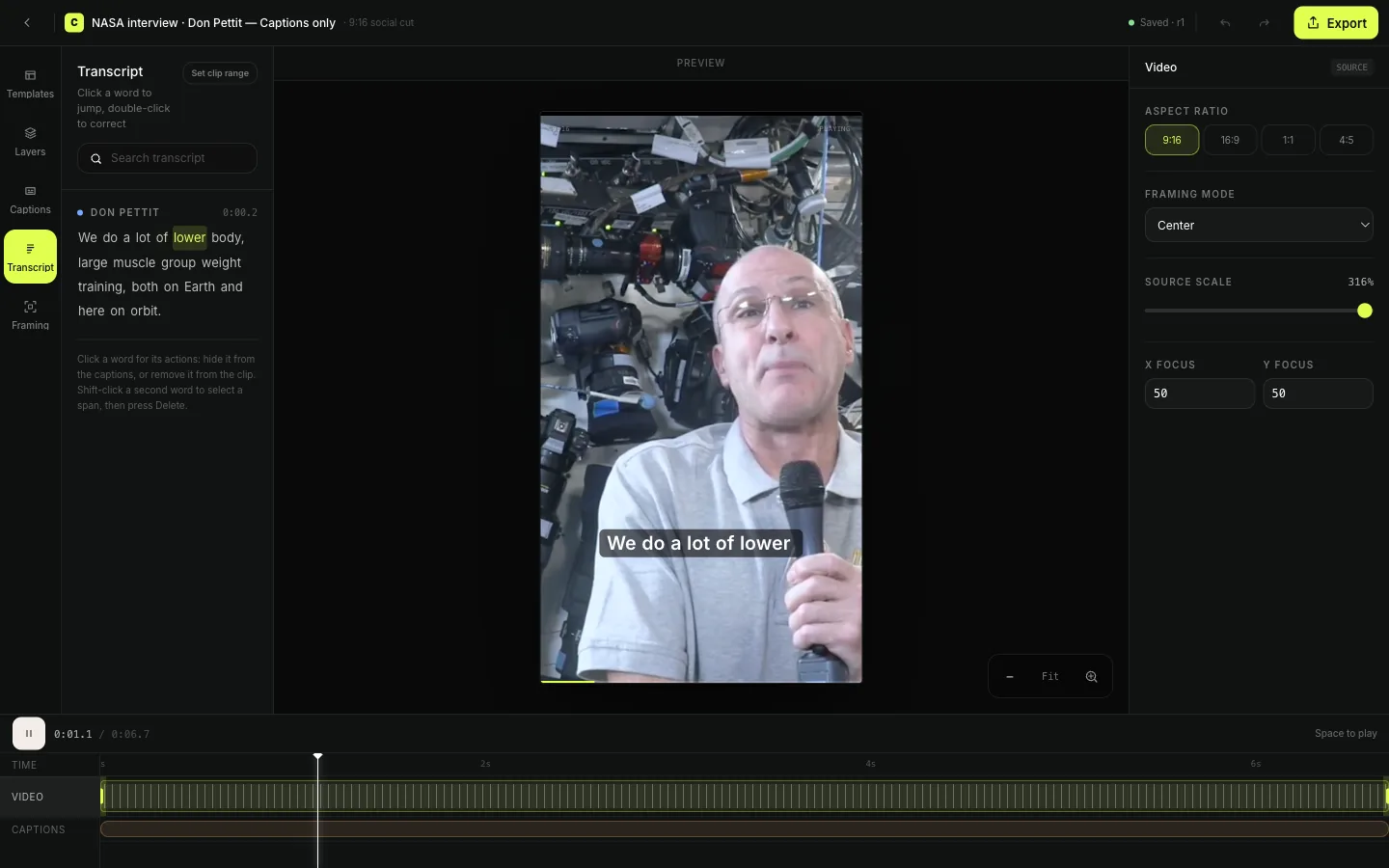
See the edit before you export
Video trimmer questions
- Can I change an AI-selected range?
- Yes. Suggested clips are starting points. Adjust their start and end in the editor before export.
- Is this a tool for joining separate videos?
- This page covers trimming a passage from a recording. It does not promise a multi-file montage or video-merging workflow.