
From spoken words to captions you can edit
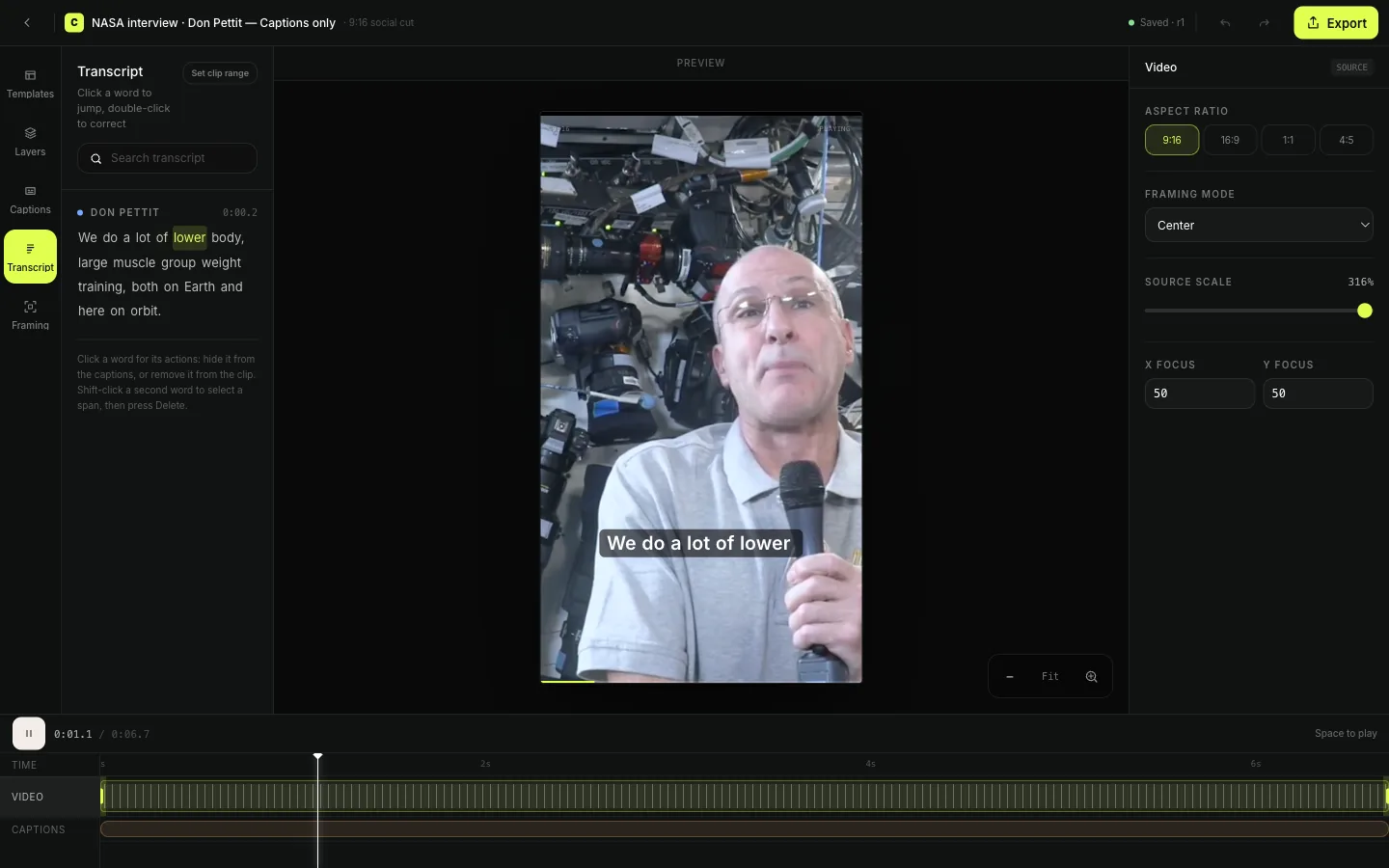
Open a clip after transcription, review the words against the audio, and choose a caption style. With word timing, correct individual words without changing their timing. Set the caption size, width, color, and position, then preview the result. A spelling correction changes the displayed text; it does not replace what the person said.
Choose readable captions before decorative ones
A fast interview needs short, readable groups of words. A screen demonstration needs captions placed away from the field the presenter is using. Test the clip at phone size with the sound off, then listen once more to check the transcription. Clyps includes 106 caption templates; the right one is the one your viewer can follow.
Try auto captions on the Free plan
Clyps Free includes 30 source minutes, 10 finished minutes, and three exports per month. Free exports have a Clyps watermark and free media expires after seven days. Creator starts at $19 monthly with 300 source minutes, 120 finished minutes, and 60 exports. Paid plans remove the Clyps watermark.
Review words that change the meaning
Start with names, technical terms, amounts, and negatives such as “not.” An error in any of these can change the point of a clip. Play the original audio while reviewing the text, especially when speakers overlap or a sentence contains an unfamiliar acronym.
Style for the footage underneath
Choose a caption style with clear contrast against the actual video. Keep text away from faces and important objects. A quiet interview can support animated emphasis; a dense screen demonstration often benefits from a simpler caption treatment. Preview at a small size before deciding.
Know which kind of subtitle you need
Clyps’ clip workflow produces video with visible captions. If a distributor requires a separate SRT or VTT file, confirm that requirement before choosing your workflow; this page does not promise a sidecar-file export. Captions burned into existing source footage are part of the image and cannot be corrected as editable text.
Worked example: fixing one caption that changes a claim
Suppose the speaker says, “Do not increase the amount,” but the transcript omits “not.” Correct that line while listening to the source before considering its visual style. Then review the quantity mentioned in the next sentence and the name of the material. Preview the captions as they appear over the actual clip, because a correct sentence can still be difficult to read if it arrives in dense blocks. Choose a quieter style when the footage already contains detailed information. This review order puts meaning first, followed by timing and presentation. It is particularly useful for demonstrations where a small transcription error could change the instruction.
When the audio is too ambiguous to caption confidently
Do not guess an unclear name or word just to complete the text. Return to the original recording, compare the surrounding speech, and use an authoritative spelling reference if available. If overlap makes the passage unintelligible, choose a cleaner excerpt. Captions should help viewers understand the recording, not manufacture certainty that the source does not contain.
Before you export
- Negatives, quantities, names, and technical terms are checked.
- The caption text matches the audible speech.
- The type remains readable over changing backgrounds.
- The required deliverable is a captioned video rather than an assumed subtitle file.
See the edit before you export
Subtitle generator questions
- Can I download an SRT subtitle file?
- This workflow puts captions directly into the exported MP4. It does not currently provide a separate SRT or VTT subtitle download.
- Can I add automatic captions for free?
- Clyps Free includes 30 source minutes, 10 finished minutes, and three exports per month. Free exports have a Clyps watermark and free media expires after seven days. Creator starts at $19 monthly with 300 source minutes, 120 finished minutes, and 60 exports. Paid plans remove the Clyps watermark.
- Is transcription the same as translation?
- No. Transcription represents the speech in text. This page does not promise translation or dubbing into another language.
- Do captions animate word by word?
- Individual-word behavior depends on the timing available in the transcript. Review the actual clip preview and choose a style that works with its timing.