
Choose a passage where reactions matter
A question, pause, and reply can be more interesting when viewers see both participants. Keep the reaction if it adds meaning to the answer. For a long uninterrupted explanation, a single-speaker composition may be clearer. Choose the layout for the passage instead of applying it to every clip.
Check each person’s framing
Review both panels through the entire excerpt. Look for changes in posture, a person leaning outside the source frame, or a cut to a different camera. A layout needs to preserve each face at those moments, not just in the opening preview.
Leave room for the spoken text
Captions should be easy to connect with the conversation without covering either face. Check where text sits relative to the panel boundary and how it wraps on a small screen. Play the exported file to verify that the layout and speech remain easy to follow together.
Worked example: a question with a visible reaction
In a two-person interview, a host asks a short question and the guest pauses before giving an unexpected answer. Keeping both faces visible can preserve the exchange and the host’s reaction. Review the entire passage to see whether either person leans outside their panel or the source switches cameras. Place captions so they do not cover the expression that makes the exchange worthwhile. Then compare the composition with a simpler speaker-focused option. Choose the split view because it communicates something in this passage, rather than because it looks more elaborate than a single crop.
When split screen adds clutter
A guest giving a detailed solo explanation may benefit from more screen space. Two panels reduce the size available to each face and to any demonstration. If the second person is visually irrelevant for most of the excerpt, use a more focused composition. Review the result at phone size, where a layout that looks balanced on a large monitor can feel crowded.
Before you export
- Both faces remain usable through the entire passage.
- The second panel contributes to understanding the exchange.
- Captions do not cover important expressions.
- The layout remains clear at a small viewing size.
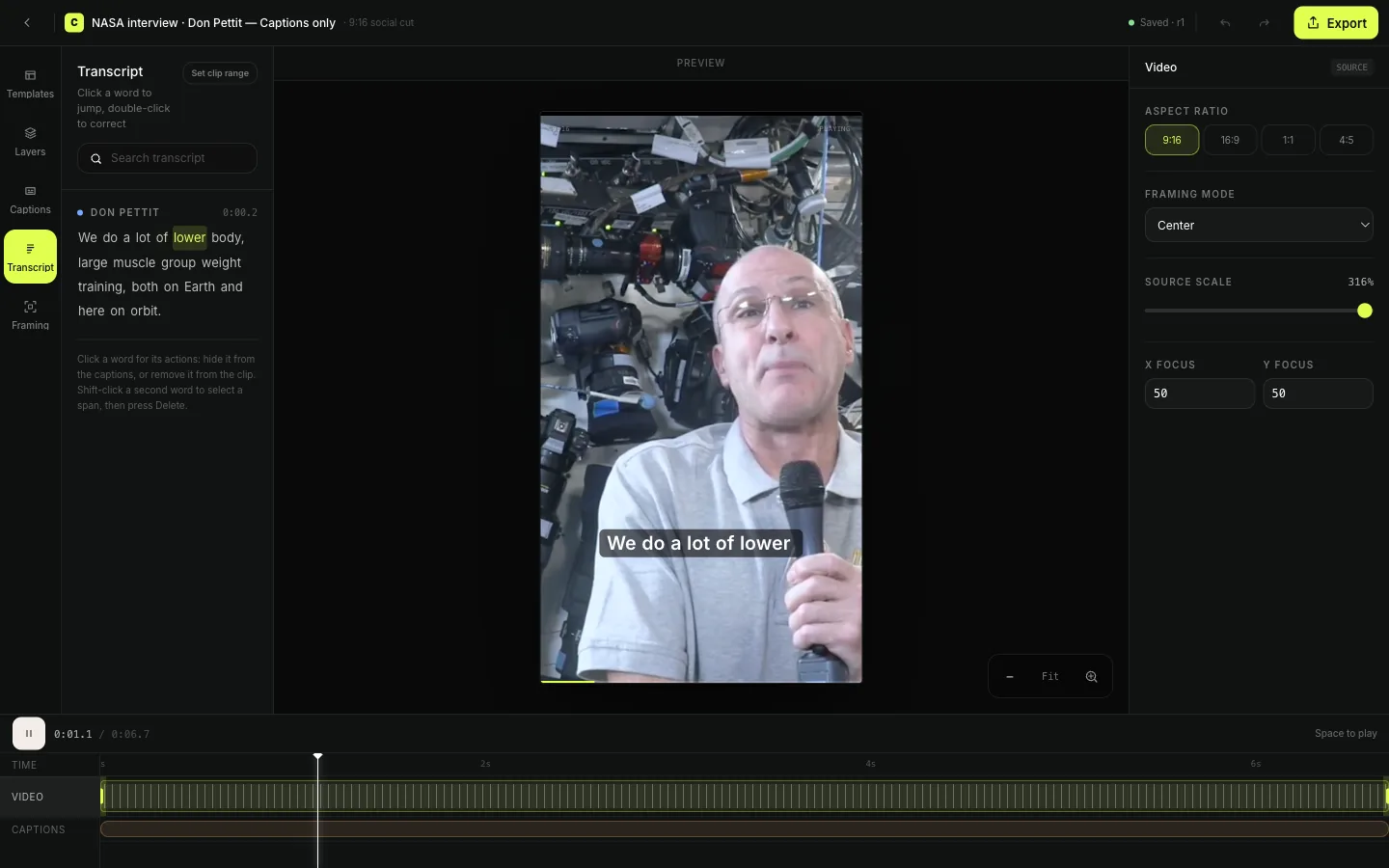
See the edit before you export
Split-screen video questions
- Can I combine any two unrelated video files?
- This page covers framing a two-person recorded conversation. It does not promise an arbitrary multi-file side-by-side video composer.
- Should every podcast clip use split screen?
- No. Use it when seeing both participants helps. A focused answer or a demonstration can work better with a different composition.