
Budget source minutes and finished output separately
Four 30-minute recordings use 120 source minutes. If each becomes four one-minute clips, the set contains 16 finished minutes and 16 exports. That fits the current Creator allowance before other usage or additional exports. Creator is $19 monthly for 300 source minutes, 120 finished minutes, and 60 exports. Check all three allowances when planning a recurring series.
Check the tool with the work you actually deliver
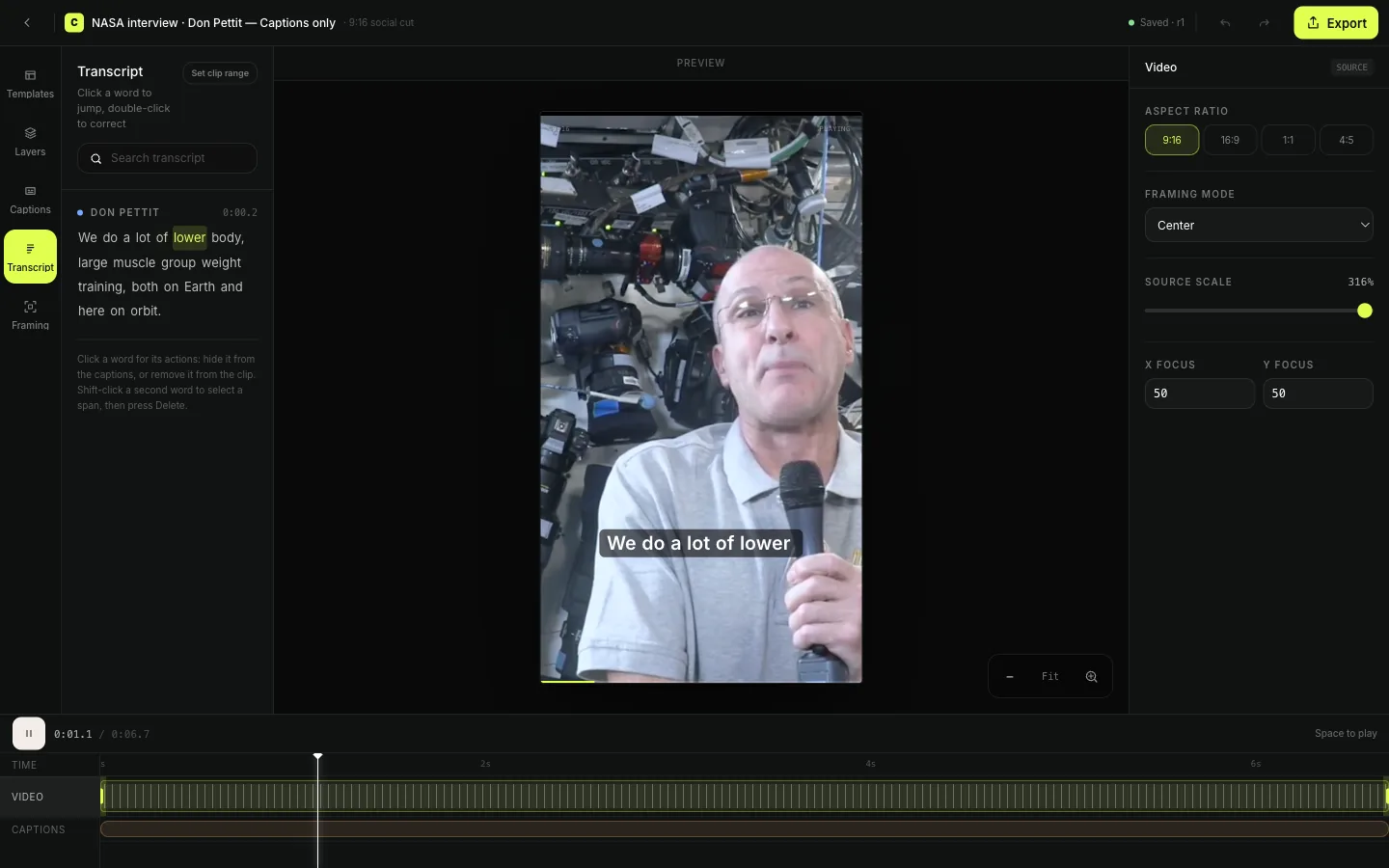
Use one recording with a speaker change and terminology your clients care about. Review the suggested range, caption correction, framing, and downloaded MP4. Add a stock cutaway only where it explains something. Clyps currently starts from a video file and does not schedule external social posts. If approvals or distribution consume most of your time, those steps still need an owner.
Write the brief before you review
Choose the audience, destination, and point each clip should make. For a customer interview, that might be one problem and one concrete outcome. For a product session, it might be one question and its answer. A brief gives the editor a reason to reject an attractive clip that serves the wrong audience.
Keep selection and finishing separate
Review candidate titles and reasons first. Open the strongest passages, verify the context, and decide which deserve finishing. Then work through framing and captions. This keeps you from polishing every suggestion before you know which ones you will use.
Check every delivery against the same standard
Listen to the opening without the source recording. Read names and numbers in the captions. Watch a speaker change for a bad crop. Confirm the requested aspect ratio and play the downloaded file before handing it over. Clyps handles the edit and export; keep client approvals and distribution in your existing process.
Worked example: a weekly founder recording
Suppose a team records a weekly conversation covering support questions, a product change, and company news. Write three delivery briefs before reviewing: one helpful answer for customers, one explanation of the change for prospects, and one internal update. Use the suggested passages to locate candidates for each brief. The internal update may not need a public clip at all. Finish the customer answer with readable captions and the relevant product terminology; give the prospect explanation enough setup to establish the problem. Keep a record of the source and destination with the exported file so the publishing owner can identify what it contains.
Where a repeatable process can go wrong
A shared visual style cannot fix a passage chosen for the wrong purpose. Avoid approving clips just because they look consistent. Review the topic and audience before the design pass, and leave enough time to check downloaded exports. If your team needs formal approvals, automation, or additional integrations, confirm those requirements separately instead of assuming they come with a web clipping tool.
Before you export
- Each clip has a named audience and delivery purpose.
- An editor has reviewed the full spoken context.
- Terminology is checked against the source of truth.
- The delivery owner knows which file belongs to each destination.
See the edit before you export
Video clipping for teams questions
- Can I test the clipping workflow before paying?
- Clyps Free includes 30 source minutes, 10 finished minutes, and three exports per month. Free exports have a Clyps watermark and free media expires after seven days. Creator starts at $19 monthly with 300 source minutes, 120 finished minutes, and 60 exports. Paid plans remove the Clyps watermark.
- Can Clyps automatically pick clips for every topic?
- Clyps suggests highlights from spoken content. Review the whole passage before choosing an export. Music-only footage, silent gameplay, and moments that depend on unseen context need a different selection process.
- Does this page offer a clipping API?
- This page covers the Clyps web editing workflow. It does not promise API access, bulk automation, or an external approval integration.
- Where do I check processing and export allowances?
- The Clyps pricing page lists current plans and usage limits. Use those allowances when planning recurring recording work.