
Select one learning outcome
Choose a passage that answers one question or demonstrates one step. A definition with a concrete example is often easier to reuse than a rapid summary of several concepts. Keep prerequisites visible: a learner who has not watched the full lesson still needs to know what the terms mean.
Protect the worked example
Do not cut the middle of a calculation or procedure just to shorten the video. If the example needs the whole board or screen, preserve that composition. Small screen text can become unreadable after a vertical crop, so judge the frame at the size students will actually use.
Review captions as instructional material
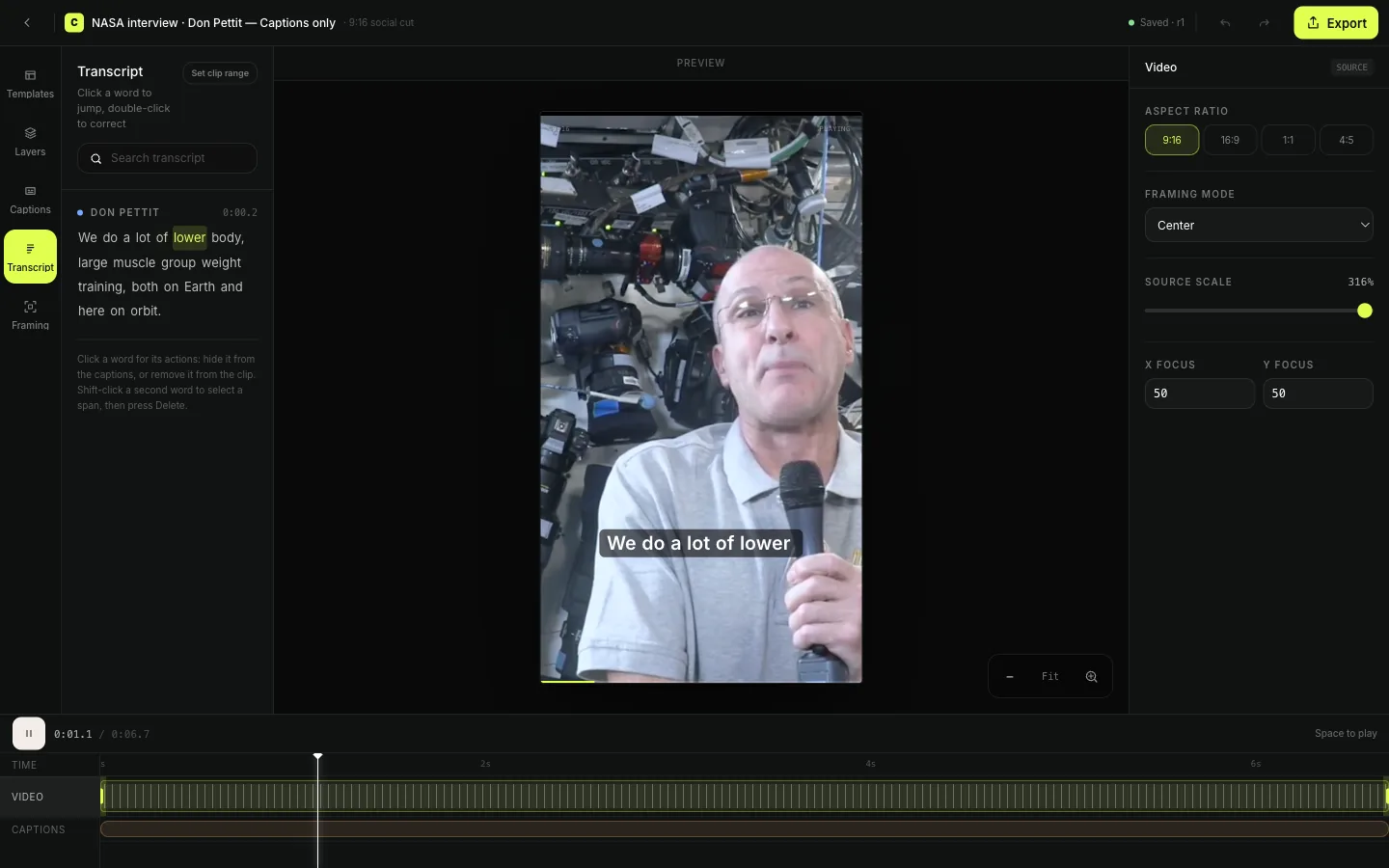
Proof specialist words, symbols spoken aloud, and numbers against the source. Captions should reinforce the explanation without covering the relevant diagram. Export the clip and pair it with the next exercise or full lesson through your learning platform or publishing process.
Worked example: extracting a complete worked problem
A recorded lesson explains several spreadsheet formulas. Select the passage that introduces one formula, applies it to a small example, and checks the result. Do not begin after the input values were named or end before the result is interpreted. Keep the relevant cells readable by choosing a suitable frame. Review the spoken formula names and numbers in the captions, then watch the exported file as if you were learning the task for the first time. If following the step requires a prerequisite from earlier in the lesson, provide the full lesson connection in your learning or publishing workflow.
Avoid removing the reasoning to keep only the answer
A short answer can be useful as a reminder for an experienced learner but inadequate as instruction for a beginner. Decide who the clip is for. Preserve the example and the condition under which the method works when teaching the concept for the first time. Length should follow that learning need rather than a generic target.
Before you export
- The clip teaches one identifiable outcome.
- Prerequisites are included or made clear in the publishing context.
- The worked example remains visually readable.
- Captioned terminology and quantities match the source.
See the edit before you export
Educational video clips questions
- Can a short clip replace the whole lesson?
- Use it for a focused explanation, reminder, or worked example. Keep the full lesson available when the topic requires more context.
- Will Clyps generate new diagrams?
- This workflow edits the lesson you recorded. It does not promise newly generated diagrams, slides, or teaching footage.